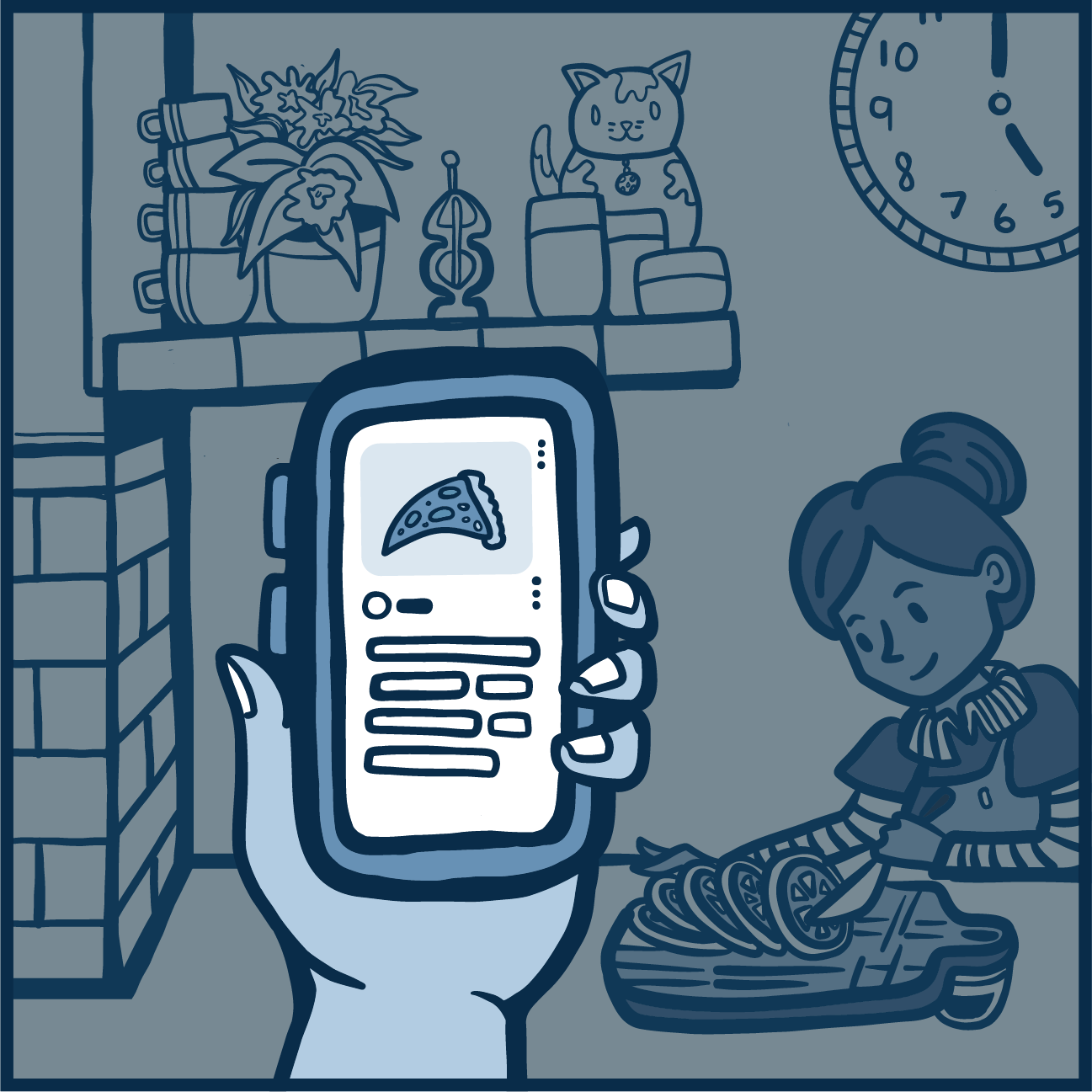
How visualizing a day in the life lead to a future-forward product strategy
Overview
When a global technology client set out to explore a new class of proactive, goal-oriented AI, they weren't looking to validate an existing product, but rather they were trying to define an entirely new one.
The challenge wasn't technological. It was based on the lived experience.
Before product decisions could be made, the team needed to understand how people navigate their everyday lives, where friction naturally occurs, life gets chaotic, and which unmet needs needed solving. AnswerLab designed a longitudinal research program to uncover those answers through qualitative research. Talking to real people about their real lives.
As design partner in this research, I sought to extend beyond just communicating these insights after the research was done I centered visualization as an active research tool, literally putting pen to paper, helping participants articulate ideas, and revealing patterns in human behavior. In doing this, we transformed complex qualitative data into frameworks that guided product strategy.
The Challenge
Emerging AI technologies often begin with what's technically possible rather than what people actually need. Our client wanted to reverse that process and remove the technological element of this narrative to understand the foundational motivations of their needs.
The goal was to identify Jobs-to-Be-Done before defining product features, ensuring that future development was grounded in authentic person-to-person behavior instead of team-based assumptions or biasies. To accomplish this, the research needed to move beyond what participants said and uncover how they actually lived.
My Contribution
My work touched all facets of the study, from design, to facilitation, to research. Throughout the engagement, I used visualization to create shared understanding and not simply to document findings.
I contributed by:
Facilitating focus groups through live visual sketching.
Translating abstract participant ideas into tangible concepts in real time.
Observing behavioral patterns as they emerged across conversations.
Identifying methodological gaps that led to a more immersive research approach.
Designing visual systems that synthesized qualitative findings into actionable frameworks.
Creating behavioral journey maps that helped product teams identify opportunities for future AI experiences.
Rather than serving as the final step in the research process, design became an active part of the discovery phase.
From Ideas to Evidence
The research began with exploratory focus groups centered around "magic wand" thinking—asking participants to imagine ideal AI solutions for everyday challenges. As I visualized these conversations live, something became increasingly clear.
Participants generated exciting ideas together, but many of their responses were shaped by the group itself. Aspirations surfaced easily. Daily realities did not. Visualizing the conversations made that disconnect impossible to ignore.
I recommended extending the study beyond group sessions into an individual diary methodology, allowing researchers to observe behaviors within the context of participants' real lives rather than within the influence of a shared discussion. That shift fundamentally changed the program. Instead of capturing hypothetical solutions, we began documenting authentic routines, emotional states, workarounds, and unmet needs as they naturally unfolded throughout the week.
The recommendation not only strengthened the quality of the research but expanded the engagement into a comprehensive longitudinal program.
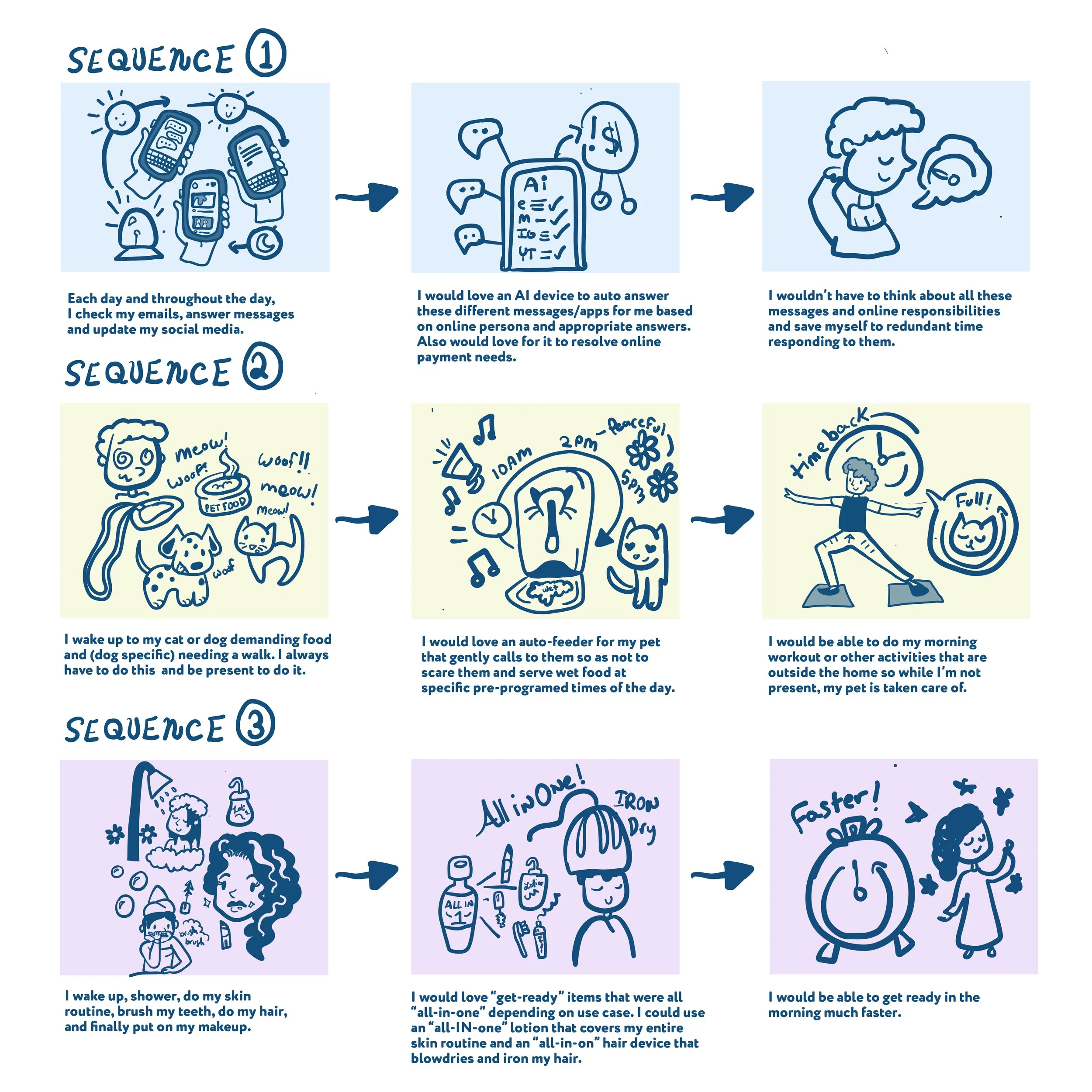
Sketches ideated in session and sequenced based on challenge, “magic wand solution,” and intended outcome.
Visual Thinking as a Research Tool
The program evolved into a three-phase study that progressively deepened our understanding of user behavior. Each phase informed the next. Focus groups established behavioral landscapes. In-depth interviews uncovered motivations and personal goals. A seven-day diary study revealed behavioral patterns impossible to observe in a single session.
Throughout every phase, visualization remained central to the research process. Working alongside researchers, I transformed observations into artifacts that allowed stakeholders to see relationships that would otherwise remain buried within transcripts and notes.
One of the most valuable outputs was a detailed Day-in-the-Life behavioral map.
Rather than summarizing participant feedback, it visualized the rhythm of everyday life—capturing routines, emotional highs and lows, technology use, recurring friction, and moments where proactive AI could meaningfully reduce cognitive effort. The map became a strategic decision-making tool, helping the client recognize opportunities before product concepts were defined.
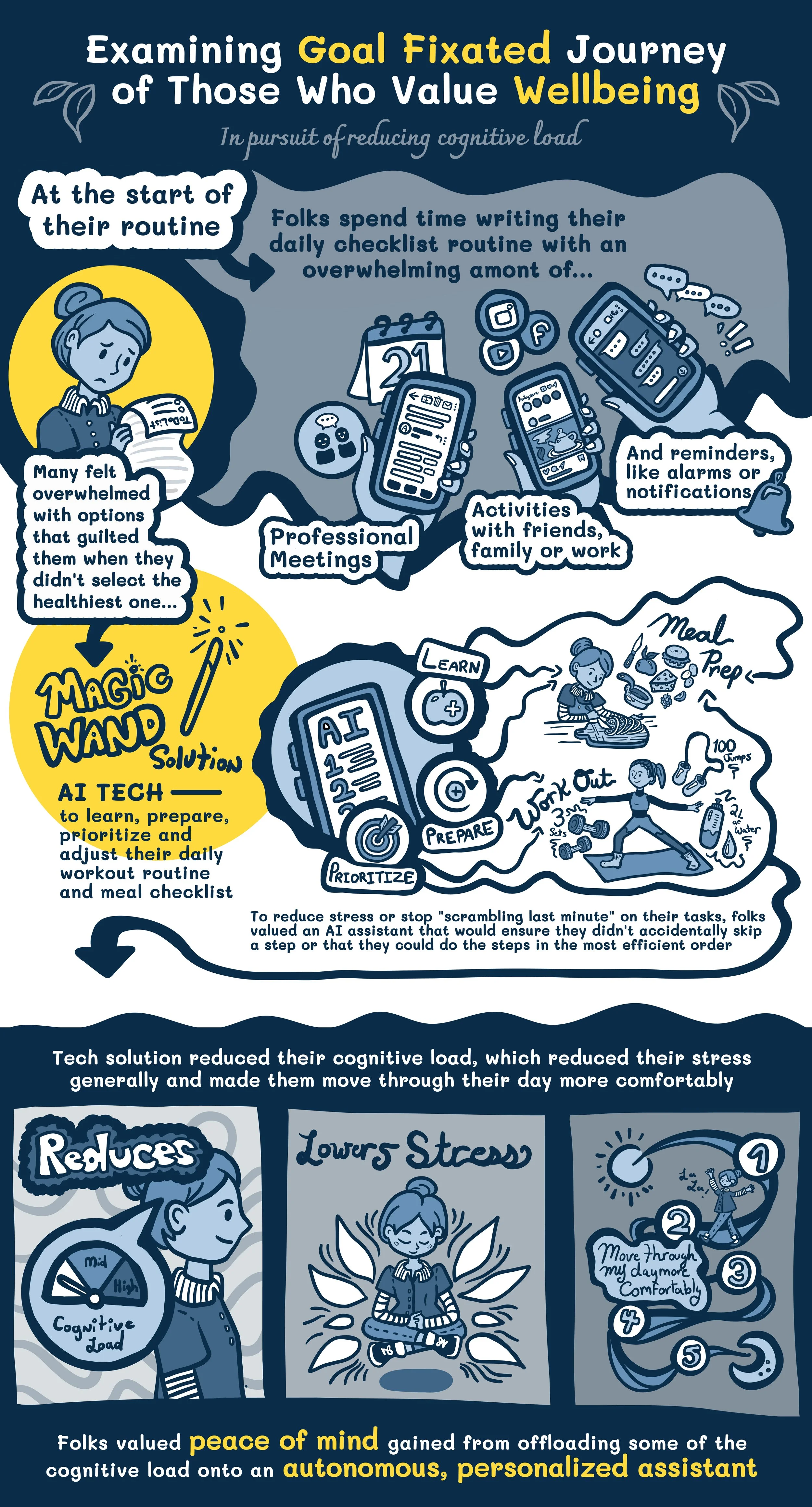
Initial concept as a infographic.
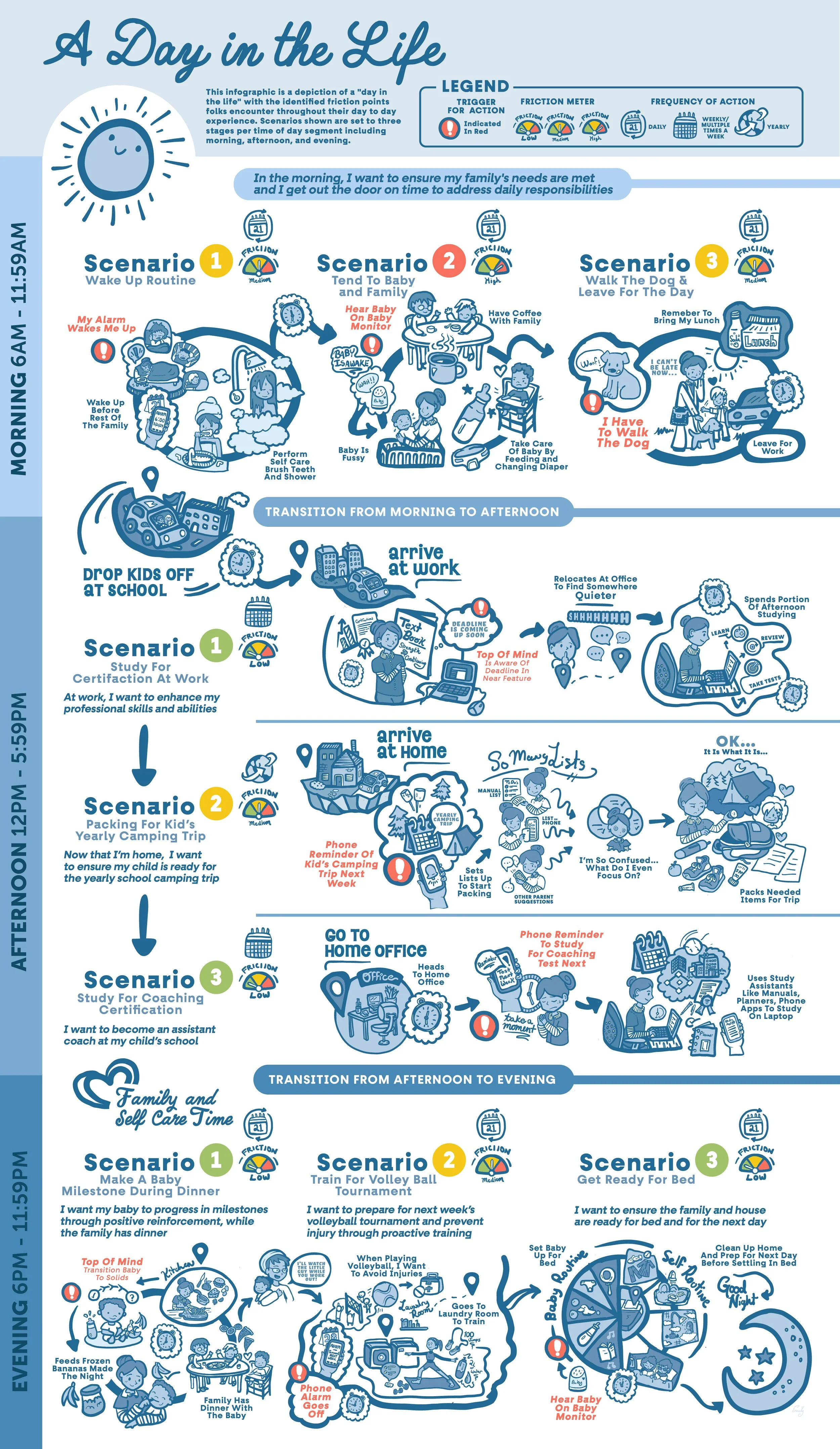
Mapped sequenced with measurable diary output for friction points and opportunities for intervention.
Business Impact
The research established a defensible foundation for an entirely new product direction.
It enabled the client to:
Prioritize opportunities using evidence instead of assumptions.
Reduce investment in low-value features before development began.
Build a reusable Jobs-to-Be-Done framework grounded in longitudinal behavioral research.
Continue future agentic AI research using a consistent behavioral model that evolved alongside the product vision.
The visual systems developed throughout the engagement also became reusable strategic assets, allowing complex qualitative insights to remain accessible long after the research concluded.
Skills Demonstrated
Visual Thinking
Art Direction
Qualitative Research
Visual Facilitation
Research Strategy
Systems Thinking
Journey Mapping
Information Design
Design Thinking
Workshop Facilitation
Behavioral Research
Jobs-to-Be-Done
Human-Centered AI
Cross-functional Leadership